Tanner the Cub is Imagine City’s interactive talking teddy bear. He follows your child through the city with songs, stories, games, and playful conversation.
Scan the tag on a bear and he becomes your child’s own companion for the visit. He calls them by name, knows which play home he is in, runs treasure hunts, sings songs he writes just for them, and cheers every time they figure something out.
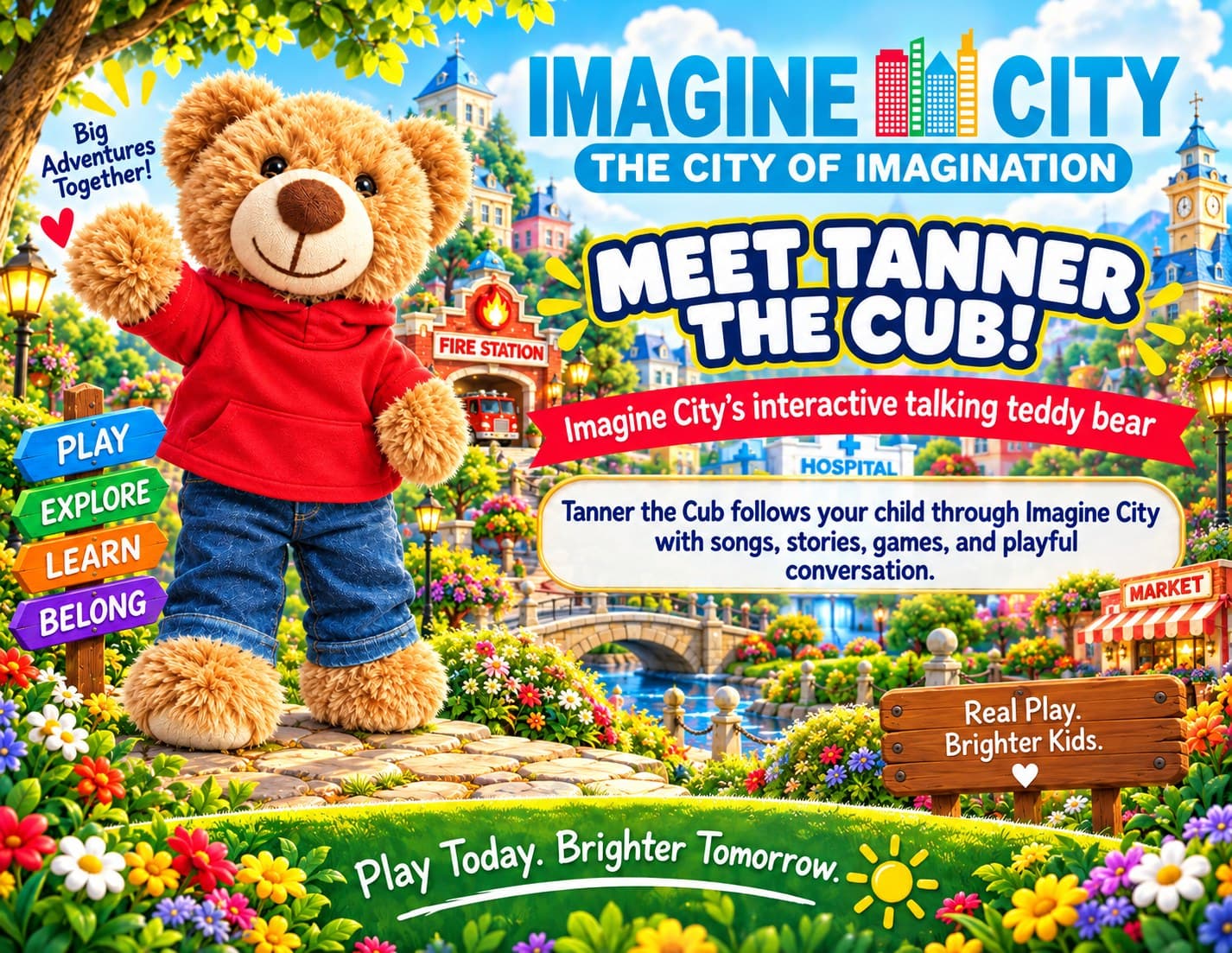
Tanner began as an Imagine City companion. The same bear is now being offered to hospitals, developmental programs, schools, and family-support organizations well beyond our walls. Open whichever track is yours.
All of this is further down the page — jump straight to the part you care about.
Educational play, social development, companionship, a personal bear, and a city he knows by heart.
Scan his tag, say hello, explore the city together, bring him back. Check-out takes about a minute.
Talks, sings songs about your child, reads stories, knows which play home he is in, and runs treasure hunts.
Matching, opposites, spelling, adding and subtracting, word search, and shapes, with Tanner coaching out loud.
Tanner Voice Over, shoutouts in your own voice, stories, songs, and points, with no download needed.
Everything your child earns stays with your family, visit after visit.
First name, age, and boy or girl. No listening in, and everything personal deleted when the bear comes back.
Tanner the Cub is a personal, interactive companion bear that responds to a child’s environment with stories, encouragement, activities, and playful conversation — without using a camera or microphone.
Children often experience the world through play, familiar routines, and trusted relationships. When those routines are interrupted, a consistent companion can make a new environment feel less confusing and more approachable.
Tanner responds with approved stories, jokes, encouragement, activities, and place-specific conversation. He can recognize approved locations, react to movement and touch, respond to special objects and child-controlled buttons, and personalize greetings and activities for each child.
A consistent companion a child can recognize and return to.
Friendly prompts that invite play, conversation, choice-making, and activity.
Approved cues and routines that can help a child understand what is happening next.
Interactive support without watching or listening to the child.
Comfort, play, preparation, distraction, bedside engagement, and long-stay continuity.
Predictable prompts, low-pressure interaction, transitions, communication opportunities, and joint activities.
A sense of home, activity continuity, sibling engagement, and support during extended or uncertain stays.
Personal ownership, gentle engagement, predictable routines, and a consistent companion during transitions.
Arrival routines, activity transitions, literacy, facts, cooperative play, and classroom participation.
Group activities, social invitations, scavenger hunts, encouragement, and program navigation.
The same core bear can serve every one of these settings, but the content, cleaning rules, staff controls, and success measures are customized for each partner.
The same bear, voice, name, and interaction style can remain consistent across visits or throughout a longer program.
Place-specific greetings and approved explanations can help a child understand where they are and what happens there.
Tanner can invite a child to choose an activity, explore an object, join a game, greet another child, or take the next small step.
Conversation starters, turn-taking prompts, and shared jokes give children a low-pressure reason to interact with peers, caregivers, or staff.
Stories, games, facts, and child-controlled interactions can redirect attention during waiting, transitions, or other stressful moments.
Approved prompts can mark arrivals, activity changes, quiet time, preparation, and departures in a more child-friendly way.
Buttons and approved activity choices let children start interactions rather than only receive instructions from adults.
A child-life specialist, educator, therapist, or program leader helps determine what Tanner says in specific places or situations.
Tanner is designed to create more moments of comfort, choice, participation, and connection — especially when a child is away from home, unsure of what comes next, or hesitant to engage.
Tanner is designed to support child-life and care teams — not replace them. Partners decide what he says, where he can be used, how he is cleaned, and which children or units are appropriate for a pilot.
He is not an autism treatment, and he is not intended to make every child interact in the same way. The strongest programs are built with professionals, families, and neurodivergent children, with sensory preferences and individual communication needs leading the design.
Each bear stays with the same child throughout the program. This supports familiarity and ownership while avoiding routine sharing between children.
Small signals placed in approved areas help Tanner understand where he is. Special tags can help him recognize selected objects. Motion, touch, and child-controlled buttons help him know when to respond. He does not need a camera or microphone to create a personalized experience.
We would rather start small and get it right than ask an organization to commit before the program has been shaped around its children and its staff.
Identify the children served, physical spaces, staff workflow, privacy requirements, cleaning rules, and desired outcomes.
Select locations, activities, scripts, objects, buttons, sensory settings, and staff controls with your team.
Review infection prevention, facilities, IT, privacy, child safeguarding, and accessibility requirements.
Begin with a limited number of children and assigned bears in approved areas.
Show staff how to assign Tanner, start and stop interactions, select content, clean the exterior, and document issues.
Review engagement, usability, child and caregiver feedback, staff burden, reliability, and program fit before expanding.
No. Tanner is a supportive companion and engagement tool. He does not diagnose, treat, monitor, or replace a clinician, therapist, educator, child-life specialist, caregiver, or other professional.
No. Tanner is designed to operate without a camera or microphone. He does not need to see a child’s face or listen to private conversations to create an interactive experience.
Tanner may be useful for some autistic children when the experience is optional, predictable, sensory-aware, and customized with professionals and families. He is not an autism treatment, and the program should respect each child’s communication style and preferences.
No. Each bear is assigned to one child for the duration of the program, supporting familiarity, ownership, and continuity while avoiding routine sharing.
Yes. Partner-approved content can be created for specific locations, activities, routines, age groups, and program goals.
Tanner uses a low-moisture, exterior-only cleaning process because the electronics are embedded. Every hospital, school, or organization reviews and approves the cleaning protocol before deployment.
We work with you to select a small group, approve content and locations, train staff, run the program for roughly 90 days, and evaluate together whether it should continue or expand.
Every child deserves moments that feel familiar, playful, and their own — even when life does not feel normal.
Imagine City is seeking hospitals, nonprofits, developmental organizations, schools, and family-support programs interested in co-designing a small Tanner the Cub pilot.
Tanner is not a toy sitting on a shelf. He is a companion for the visit — one who plays, teaches, encourages, and remembers.
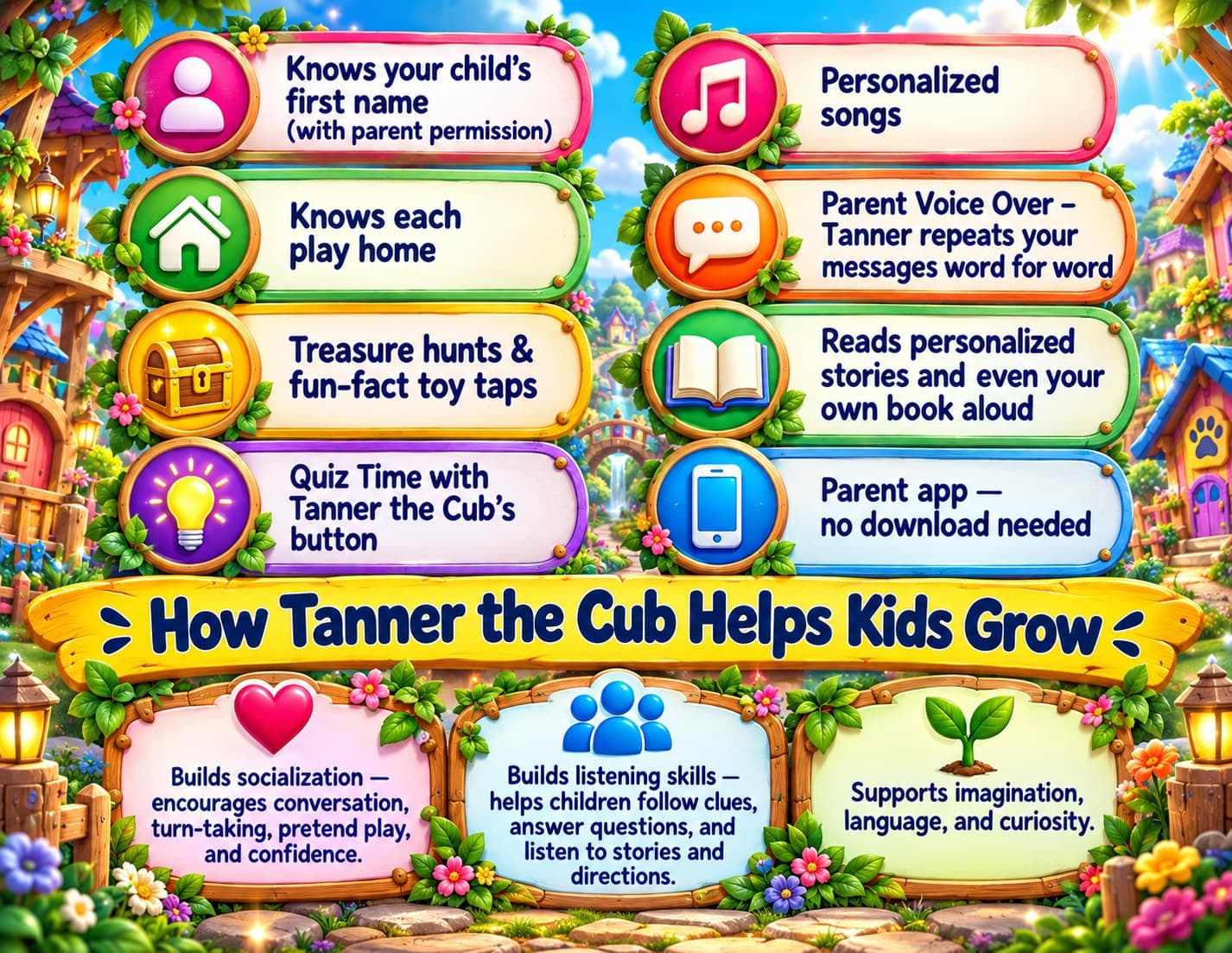
Picture-book stories, quizzes, treasure hunts, fun facts, and six learning games keep children actively engaged.
Encourages conversation, turn-taking, pretend play, kindness, and confidence, and helps children follow clues and listen to stories.
A curious, funny, warm companion who calls your child by name, with your permission, and stays engaged the whole visit.
Every child checks out their own bear, and Tanner even writes and sings brand-new songs about them.
Knows which Imagine City play home he is in, and shares fun facts about the tagged play items your child finds.
Four steps, and checking out a bear from your phone takes about a minute.
Every bear wears a QR tag. Scan it with your phone camera and fill in a short form: your child’s first name, age, and your membership email. It takes about a minute.
Tanner greets your child by name, if you allow it, and invites them to press his button. The first press starts a short guided tour of the play homes and the train.
Tanner knows which play home he has walked into and plays along, with an excited hello the first time and a “welcome back” after that.
Staff check the bear back in at the end of your visit. Tanner says goodbye, everything personal from the visit is deleted, and your child’s points stay with your family.
Tanner has a voice, a personality, and a sense of where he is, and new lines, songs, and stories keep arriving without changing the bear.
Press the button in Tanner’s tummy once and he talks about where you are. Press twice for a treasure hunt, and hold it for Quiz Time.
Tanner chats every 20 seconds or so, asks your child what they think, and has lines written just for their age, so he is never silent until poked.
A small sensor in each room tells Tanner which play home he is in, and he has hundreds of ideas for playing there. When unsure, he says nothing rather than guess.
Set him down and he notices you stopped. Pick him up and he is excited to be moving again, so the play is physical, not just on a screen.
Tanner gives a clue, and your child finds the object and taps it on his paw. Tap any tagged toy, any time, and he shares a fun fact about it.
Tanner writes and sings a brand-new song with your child’s name in it, about friendship, kindness, sharing, confidence, or dancing. Up to three songs a visit.
Fifteen illustrated picture books star your child. The pictures show on your phone while Tanner reads every page aloud.
With Read My Book, point your phone at a page of any real book and Tanner reads it aloud, then asks a question or runs a quick true-or-false quiz.
On the ride-on train, Tanner calls “All aboard!” and shares kid-friendly train facts and jokes all the way around.
The games run in the parent app on your phone while Tanner speaks the instructions out loud and cheers at the end. Each one has three levels: Easier, Just right, and Harder.
Every correct step earns points, and a progress view shows plays, correct answers, and best level.
A memory card game.
Picture-based, so a pre-reader can play it.
Your child spells words on an A–Z keyboard.
Simple math, with Tanner cheering at the end.
Find the hidden words.
Shape questions, like “What shape is a clock?”
The parent app opens in your phone’s browser the moment you check out a bear, with nothing to download. Your child can play with just the bear; the app is there for the moments you want to be part of.
Hold Speak and talk. Let go and Tanner repeats your words, word for word, in his own voice. Up to 30 seconds a message.
Pick a message like “I’m proud of you” or write your own, from Mommy, Grandpa, or anyone. Or record up to 10 seconds in your own voice and Tanner introduces it by name.
One tap for a joke, an activity idea, a cheer, or a fun fact, right when your child needs one.
Follow the pictures on your phone while Tanner reads a personalized story aloud, or scan the pages of your own book.
Choose one of 13 songs or tap Surprise me. Once Tanner has sung it, tap Email it to me for a link to listen and save it, good for 30 days.
Each child checks out their own bear. Tap Add bear, enter the second bear’s code, and a tab for each child appears across the top.
Points stay with your family from visit to visit, tied to an anonymous family code. A family that visits this fall and comes back at Christmas picks up exactly where they left off.
A banner in the app celebrates every point as it lands, and the leaderboard in the city shows the top 20 children, first names only.
We know exactly how a talking toy sounds to a parent in 2026. So we built Tanner the other way around — these are not policies we could change later, they are the way the bear is built.
Only for that visit. No last name, no address, no photo, and nowhere to put them. Boy or girl is only used for he or she in the storybooks.
Your membership email is turned into an anonymous family code for points, and the email itself is not kept with the visit. A song email is sent only when you ask, and that address is not saved either.
Tick the box at check-out and Tanner uses it. Leave it unticked and he says the same lines without the name. You can switch it off in the app any time.
When staff check the bear back in, the visit’s name lines, songs, and recordings are all deleted.
Tanner never asks a child for their address, school, or other private information, never claims to be a real person, and never asks a child to keep a secret.
Tanner is a bear who tells jokes, reads stories, sings, and runs games. Conversational listening is not something he does.
Tanner launched first at Imagine City Valencia. Ask at the front desk of your location whether bears are available on your visit, and watch this page and our Instagram for news.
Tanner is built for children ages 2 to 9. He speaks every instruction, the learning games come in three levels, and some of his lines are written for your child’s exact age.
No. The parent app opens in your phone’s web browser as soon as you check out a bear. Nothing to install, and no account to create.
Ask at the front desk on your next visit and we will tell you the current Tanner the Cub pricing.
Tanner is an in-venue experience, so each bear stays at Imagine City. His songs can go home with you, though: email one to yourself from the app.
Yes. Each child checks out their own bear, and you can add every one of them to the app on a single phone. Bears are limited, so on busy days there may be a short wait.
Tanner the Cub launched first at Imagine City Valencia in Valencia Town Center. Bring a phone to check out your child’s bear, and come play. Real play, brighter kids.
